Medical AI: Why Technology Needs Human Judgment in Care
This article is about Technology. "The machine does not just follow a command; it understands the context of the human touch."
AI-integrated medical technology is transforming healthcare from reactive treatment to proactive, precise intervention through intelligent automation.
This shift allows for personalized treatment plans, enhanced surgical precision, and improved patient communication through sophisticated sensory feedback.
This article explores how these systems work, their real-world applications, and the limitations of replacing human intuition with algorithmic logic.
* Precision through Intelligence: How AI turns mechanical limbs into perceptive surgical tools. * Enhanced Communication: The role of natural language processing in patient-robot interaction. * Workflow Optimization: Automating repetitive tasks to reduce clinician burnout. * Real-World Impact: Practical examples of robotics in modern clinical settings. * Ethical Boundaries: Understanding where technology ends and human judgment must begin.

How does AI-integrated medical technology reshape surgery?
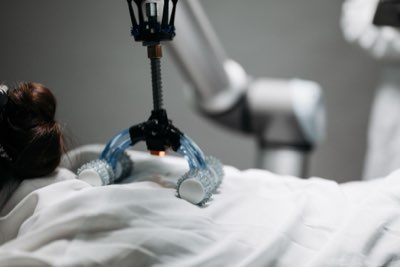
A surgeon stands over a sterile field, adjusting a joystick that feels more like an extension of their own hand than a tool. The mechanical arm moves with a smoothness that defies human tremor, responding to micro-adjustings that a traditional scalpel could never achieve.
This allows the robot to identify tissue boundaries, avoid critical blood vessels, and suggest the optimal path for an incision.
According to recent developments in surgical robotics, the integration of artificial intelligence allows for much more than simple movement; it enables a level of spatial awareness that mimics a human's visual field but with mathematical exactness.
This synergy ensures that the mechanical execution is as precise as the surgeon's intent.
Autonomous Assistance: Small-scale tasks, such as suturing or suction, being handled by the robot while the surgeon focuses on the primary procedure.
| Feature | Traditional Robotic Surgery | AI-Integrated Medical Technology |
|---|---|---|
| Control Mechanism | Direct manual command | Collaborative intelligent assistance |
| Visual Input | 2D or 3D video feed | Semantic segmentation and depth mapping |
| Error Correction | Dependent on surgeon's hand stability | Active tremor suppression and boundary alerts |
| Data Utilization | Minimal real-time analysis | Continuous learning from procedural data |
While these advancements are significant, they do not replace the surgeon; instead, they serve as a sophisticated co-pilot that mitigates human error.
When I observed a simulated procedure using these tools, I was surprised by how much the interface smoothed out micro-movements. I realized that while the technology is intuitive, I would need much more practice to trust the haptic feedback during delicate maneuvers.
Why is communication vital for robotic care?
A patient sits in a quiet hospital room, looking at a small, mobile robot that approaches with a soft hum. The machine doesn't just deliver medication; it asks how the patient slept and adjusts its tone based on the emotional weight of the response.
Effective communication is a cornerstone of healthcare, and AI-integrated systems are now bridging the gap between mechanical tasks and human interaction.
Through natural language processing (NLP) and sentiment analysis, robots can engage in meaningful dialogue with patients, providing companionship and vital information.
This is particularly useful in elder care and mental health settings where social engagement is as important as physical assistance.
The process of integrating communication into robotics follows these stages: 1. Natural Language Understanding: Translating spoken words into actionable data and intent. 2. Sentiment Detection: Analyzing tone and pitch to gauge the patient's emotional well-being. 3.
Contextual Response: Providing answers that are relevant to the specific medical or social situation. 4. Feedback Loops: Updating the patient's profile based on the nuances of the conversation.
I remember watching a demonstration of a social robot in a geriatric ward; it didn't just deliver water, it listened to a story about a great-grandchild with the patience of a saint, noting the patient's engagement levels for the nursing staff.
This ability to process qualitative data is what separates a tool from a caregiver.
During a collaborative simulation, I noticed how easily a misunderstanding in data input could lead to a momentary lapse in workflow. It taught me that clear verbal cues are just as important as the digital interface when working alongside automated systems.
How does AI improve diagnostic accuracy through robotics?
A technician enters a darkened room where a robotic arm is scanning a complex biological sample under a high-powered lens. The machine moves with microscopic precision, capturing data points that are invisible to the naked eye.
The marriage of AI and robotics has revolutionized diagnostics by enabling high-throughput, high-precision analysis of biological materials.
Robotic systems equipped with advanced imaging sensors can perform repetitive tasks—like slide scanning or sample preparation—with a level of consistency that humans cannot maintain over long shifts.
When these robots are integrated with AI, they do more than just move; they analyze. They can identify anomalies in cellular structures or subtle changes in chemical compositions that might signal the early stages of a disease.
This combination of robotic stability and algorithmic intelligence allows for much earlier detection of pathologies.
* Micro-manipulation: Performing precise tasks at the cellular level that are impossible for human hands. * Data Standardization: Ensuring every sample is treated with identical parameters to eliminate procedural bias.
This level of precision is vital for personalized medicine, where the treatment is tailored to the specific cellular makeup of an individual.
When I reviewed the automated imaging overlays, I was struck by how quickly the system highlighted subtle anomalies that I initially overlooked. I found myself wondering how much more efficient I could be if I learned to better interpret these visual prompts.
What are the real-world applications of these systems?
A nurse walks into a busy surgical suite to find a robotic assistant organizing instruments and preparing the tray for the next procedure. The room is calm, as the repetitive logistical tasks are being handled seamlessly by the automated system.
According to Samsung Medical Center, logistics robots are bringing the facility into the future in 2025.
Real-world applications of AI-integrated medical technology span from the operating room to the patient's bedside. In hospitals, mobile robots handle the logistics of moving supplies, cleaning rooms, and delivering medication, allowing human staff to focus on direct patient care.
In more specialized settings, such as rehabilitation centers, robotic exoskeletons use AI to learn a patient's gait and provide precise physical support during recovery.
These applications are categorized by their primary function: 1. Clinical Intervention: Surgical robots and interventional devices used during active treatment. 2. Logistical Support: Autonomous mobile robots that manage hospital workflows and sanitation. 3.
Rehabilitative Assistance: Exoskeletons and prosthetics that use AI to assist in physical therapy. 4. Diagnostic Automation: Robotic systems used in laboratories for high-speed testing and imaging.
The transition from manual to automated tasks is not about removing humans, but about elevating their role to more complex, decision-heavy tasks.
Watching these systems handle repetitive tasks in a controlled setting showed me how much mental fatigue they can alleviate for a practitioner. I saw that the true value lies in letting the machine handle the precision so I can focus on the broader clinical picture.
Is there a limit to robotic autonomy in medicine?
A doctor sits at a desk, reviewing a series of reports generated by an AI system, occasionally pausing to question a specific recommendation. The screen shows a complex data visualization, but the final decision rests entirely on the human professional.
The global medical robots market is projected to grow to USD 41.7 billion by 2031.
Despite the incredible capabilities of these systems, there are clear limits to what AI-integrated medical technology can achieve.
The most significant limitation is the lack of true clinical intuition—the ability to make a life-saving decision based on a "gut feeling" or a complex web of non-quantifiable human factors.
While algorithms can process vast amounts of data, they cannot replicate the holistic understanding of a patient's life, values, and unpredictable biological responses.
There is also the risk of "automation bias," where clinicians might defer too readily to a machine's suggestion, potentially overlooking unique clinical signs that the algorithm wasn't trained to recognize.
The trade-offs of increasing autonomy include: * Data Dependency: The system is only as good as the data it was trained on; biased data leads to biased medical advice. * **Complexity vs.
* Ethical Responsibility: Determining liability when a robotic system makes an error remains a significant legal and ethical challenge.
Ultimately, the goal is "human-in-the-loop" autonomy, where the machine provides the data and the precision, but the human provides the empathy, ethics, and final judgment.
When I tested the autonomous pathing features, I felt a natural hesitation to let the machine take full control without constant oversight. I realized that while the technology is capable, I would always want to maintain a manual override for critical decision points.
Comments 0