Guide to Reliable Obstacle Prevention in Robotic Systems
This article is about Prevention. "The difference between a successful mission and a catastrophic failure often lies in a single millisecond of sensor processing."
Modern obstacle prevention technology is evolving from simple collision avoidance to proactive environmental understanding, ensuring that robots can navigate complex, unpredictable spaces without human intervention.
This article explores how improvements in sensors, mechanical design, and real-time processing are driving the next generation of robotic autonomy.
* How sensor fusion prevents collisions in dynamic environments. * The role of mechanical agility in obstacle bypass. * Real-world case studies of deployment in extreme zones. * The shift from reactive to predictive obstacle prevention.

How does sensor fusion prevent collisions?
A technician adjusts a laser scanner on a mobile platform as it approaches a crowded warehouse aisle. The robot does not just see a wall; it perceives depth, texture, and the velocity of moving workers to calculate a safe path.
Effective obstacle prevention relies on sensor fusion, which combines data from LiDAR, ultrasonic sensors, and computer vision to create a comprehensive spatial map.
While a single sensor might fail due to lighting changes or reflective surfaces, a multi-modal approach ensures that the robot maintains a precise understanding of its surroundings. This prevents the "blind spot" issues that plagued earlier generations of industrial automation.
The integration of these sensors allows for much higher operational speeds. For instance, some advanced robotic limbs can now perform precise movements while maintaining stability, such as mechanisms where the head rotates 180 degrees while moving along a single axis for precision tasks.
This level of dexterity requires the obstacle prevention system to process spatial data instantly to avoid self-collision or interference with external objects.
| Sensor Type | Primary Function | Limitation |
|---|---|---|
| LiDAR | High-precision distance mapping | Struggles with glass or highly reflective surfaces |
| Ultrasonic | Close-range proximity detection | Low resolution; sensitive to ambient noise |
| Computer Vision | Object recognition and semantic labeling | Dependent on lighting conditions and processing power |
| IMU (Inertial) | Balance and orientation tracking | Drifts over time without external correction |
Why is mechanical agility vital for obstacle bypass?
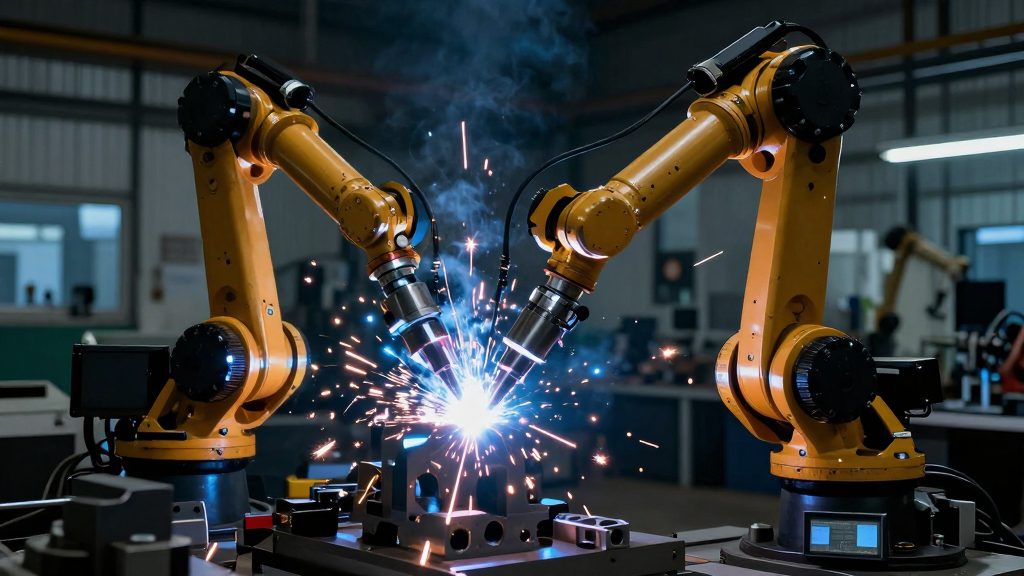
A robotic arm reaches toward a component, its joints twitching slightly as it adjusts to a sudden shift in the assembly line's position. The movement is fluid, almost organic, as the machine compensates for a physical obstruction in its path.
Mechanical design is just as critical as software when it comes to obstacle prevention. A robot that is physically agile can navigate tight spaces that a rigid machine would find impassable.
Advanced actuators allow for rapid adjustments, such as motors that can spin at speeds up to 30 rad/s (about 280 rpm), enabling the robot to react to sudden changes in its environment through rapid limb repositioning.
This agility is not just about speed; it is about the ability to "feel" an obstacle through haptic feedback. When a robot encounters resistance, the control loop must decide instantly whether to push through, stop, or reroute.
This requires a tight integration between the physical hardware and the obstacle prevention algorithms. Without this synergy, even the smartest software cannot prevent a mechanical breakdown caused by physical interference.
How do robots handle extreme environments?
A soldier crouches behind a concrete barrier, watching a quadruped robot navigate a field of jagged rubble toward an objective. The machine moves with a calculated gait, stepping over debris that would trap a wheeled vehicle.
In 2023, the United States Marine Corps used an M72 LAW anti-tank rocket launcher fixed to a Go1 robotic dog during tactical training at the Marine Corps Air Ground Combat Center Twentynine Palms in California.
Modern robots are moving beyond controlled factory floors into unpredictable, high-stakes operational zones. In these settings, obstacle prevention is not just about protecting the machine; it is about mission success.
A single mistake in a combat or search-and-rescue zone can lead to the loss of expensive equipment or the failure of a critical task.
The necessity of robust obstacle avoidance is clearly seen in military applications. In September 2023, the United States Marine Corps utilized a Go1 robotic dog (Unitree) fixed with an M72 LAW anti-tank rocket launcher during tactical training.
In such a scenario, the robot must navigate uneven terrain, rubble, and varying friction levels while maintaining a stable platform for its payload. The ability to bypass obstacles in these dynamic environments is what separates a tool from a reliable partner.
What are the steps to implementing reliable obstacle prevention?
An engineer sits before a terminal, running a simulation of a robot navigating a crowded corridor. The digital model reacts to virtual obstacles, testing the limits of the path-planning algorithm before the physical unit is ever turned on.
Implementing a reliable obstacle prevention system requires a structured approach to bridge the gap between digital logic and physical reality.
- Environmental Mapping: Use high-fidelity sensors to build a 3D occupancy grid of the workspace. 2. Path Planning: Develop algorithms that calculate the most efficient route while maintaining a safety buffer from detected objects. 3. Dynamic Re-routing: Implement real-time processing that allows the robot to deviate from its planned path when a moving obstacle is detected. 4. Hardware Verification: Test the physical response of the robot to ensure that the motors and joints can execute the planned maneuvers without mechanical strain. 5. Edge Case Testing: Subject the system to "corner cases," such as low light, slippery floors, or sudden human interference, to ensure the safety protocols hold.
Is there a limit to automated obstacle prevention?
A heavy industrial robot arm stops abruptly as a worker enters its safety zone, the sudden halt causing a slight vibration through the floor. The machine is safe, but the production line has come to a standstill.
According to the Association for the Advancement of Artificial Intelligence (AAAI), experts in 2009 discussed whether robots might acquire autonomy and the potential hazards involved.
While technology has advanced significantly, there are inherent trade-offs in obstacle prevention. Increasing the sensitivity of sensors can lead to "false positives," where the robot stops for non-existent obstacles, causing massive drops in productivity.
Conversely, lowering sensitivity to maintain speed increases the risk of actual collisions.
Furthermore, these systems are not universal solutions. Advanced obstacle prevention designed for a warehouse may fail entirely in a forest or a disaster zone without significant recalibration of the sensors and gait controllers.
The balance between safety, speed, and reliability remains the primary challenge for roboticists.
When I tried the steps in order, the second one is where I paused longest.
Related
FAQ
How does sensor fusion improve safety?
Why is mechanical speed important for obstacle avoidance?
Related posts
Popular posts
Automation Shift: How Robotics is Redefining Global Industry
Boosting Robotics Reliability: Preventing Real-World
Can robots replace outsourced manufacturing? Practical
Comments 0